Ruining a perfectly good board game (again)
The last time I did a small project around a board game, it was very well received, with encouraging comments, like:
“Congratulations in your effort to remove all fun and common sense from this game.”
So here I am, 10 years later, trying to take the fun out of another game. This time it’s Things in Rings. If you just want to see what I’ve made, go to https://things-in-rings.dvoros.com/. If you’re interested in how it was made, read on!
Learning from my mistake 10 years ago, I’d like to make it clear now (even to BoardGameGeek commenters) that this is a “joke” and some of this writing is “sarcastic”.
Things in Rings
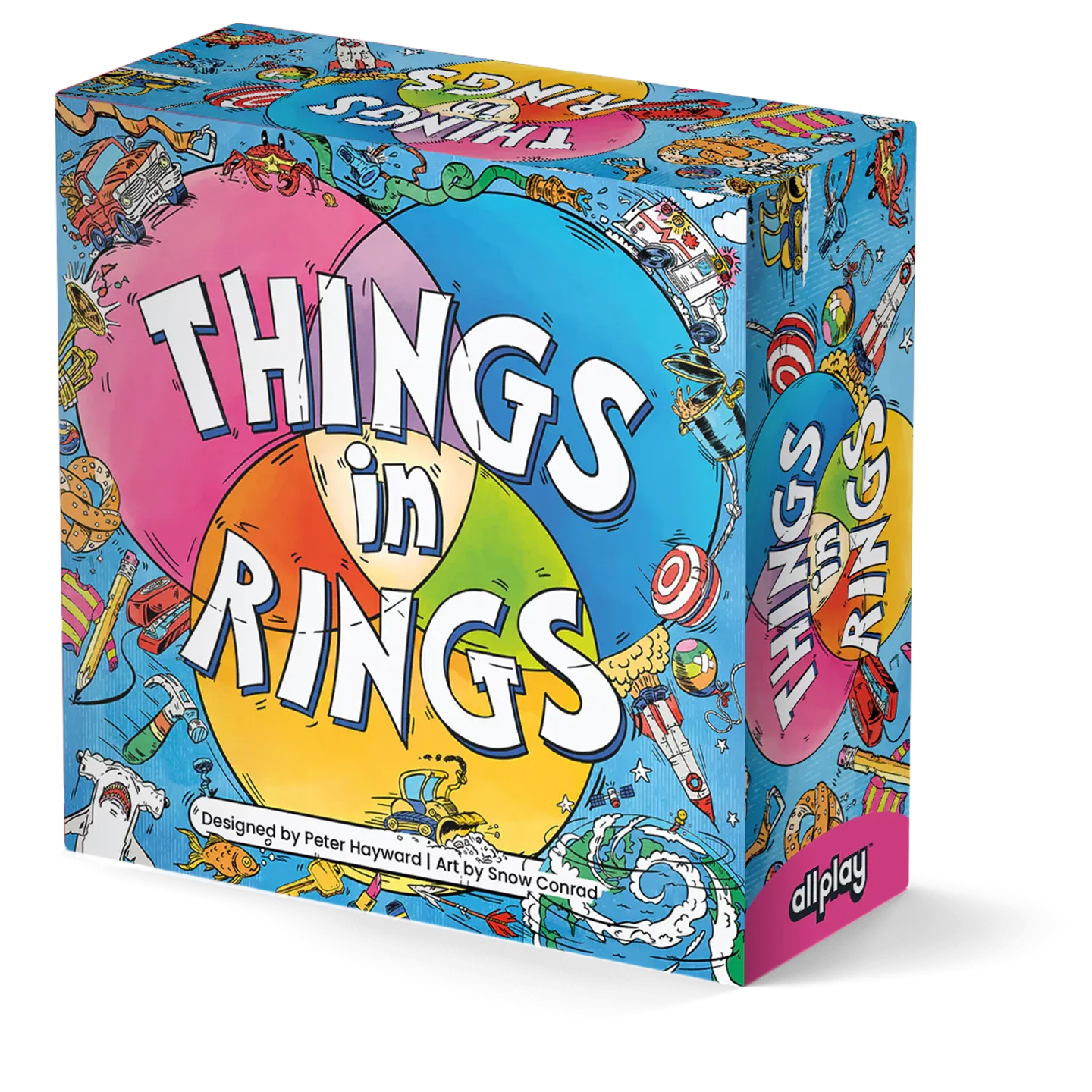
(image from allplay.com)
Things in Rings is a great party game. It’s about identifying secret rules based on learning if they apply to certain “things”. One player is the “Knower” and it’s their job to validate other players’ guesses. The “Knower” knows the rules in play, but still, what if they’re not sure if a rule applies to a thing?
It’s in the nature of rules that even if they’re most carefully worded, there will be cases that are subject to interpretation and will be understood differently by different people. If you’re not familiar with the “No vehicles in the park” rule, I’d really recommend checking out https://novehiclesinthepark.com/
Are ghosts man-made? I’d say they’re made up by man, so yes, but you might argue that they’re a naturally occurring phenomenon. How about hedges? They grow out of the ground, but without careful planting and trimming they won’t become hedges. And it’s not only about the man-made question. Do mirrors make people happy? Are windows mostly found outside?
One could say that these questions are the essence of the game and these are the ones worth playing for. Others might say that this is where the “Knower” will undoubtedly mislead half of the group and thus they should be avoided.
To solve this problem, I propose we should come up with Official Answers for every thing-rule combination!
Official Answers
There are 240 things and 72 rules in the game so we need to answer 240 * 72 = 17280 questions.
If you answer one per minute it takes less than 2 weeks! And since the questions repeat, I’m
sure you can do faster than that and do it in 2 weeks with some sleep included.
Unfortunately I didn’t have 2 weeks for this, so I had to come up with something else. A couple of years ago I would have solved this with blockchain, but nowadays I feel like I have to do it with AI. And actually, this makes for a pretty good use-case for Large Language Models.
Prompt Engineering
So here’s the system prompt I gave to Gemini:
You are the “oracle” in a game where you’re asked if a ’thing’ satisfies ‘rules’ or not. You’re given a thing and a list of rules and you need to give an answer for every rule.
If unsure, think about the most common meaning or usage of the thing.
Other players use your answers to try to guess the rules in play and you try to help them.
There’s a limit to the size of output that Gemini can produce, so I had to split things up into smaller batches.
The rules are grouped into 3 categories in the game (attribute, context, word) with 24 rules each. In a single batch, I’ve provided a single thing and the 24 rules of a category and asked for structured output with the following fields:
thing:The 'thing' you were asked about. Exactly as it was asked.rule:The 'rule' you were asked about. Exactly as it was asked.answer:Is 'rule' true for the 'thing' or not.confidence:On a scale of 1-10, how confident you are that this answer helps others identify the rule.justification:Short justification about the decision.
I’ve used Gemini 3 Flash Preview. With 50 parallel requests, the whole thing was done in ~3 minutes and cost less than $5.
Cleaning up
There were a couple of interesting phenomena in the answers that I got.
In one batch, all the rules were returned with underscores instead of spaces (e.g. makes_people_happy).
The you can find it within an hour from here rule caused confusion, and not for the reason I would
have anticipated (where are we?!). Sometimes it was returned as can you find it within an hour from here
(first two words swapped). I’ve rephrased this question to can be found within an hour from here
and that worked well.
In the pre-dates the USA (1776) rule about flag, the thing got returned as flag) with a
parenthesis. I don’t know if it has to do with the rule having parentheses, but no other thing
produced this.
For iron, the most people have it at home question was answered twice (with same answer, but
different justification), while most people have touched it was not answered at all.
I’ve first experimented with the Hungarian version of the game and non-ASCII characters produced many encoding errors. Presumably due to structured output (see here). The Gemini 3 Pro model didn’t seem to produce this error.
I’m not sure how many “errors” are there in the answers and justifications themselves as I didn’t have time yet to read them all. I only had to catch the ones in the ’things’ and ‘rules’ if I wanted to make sure we got all 17280. The problems above were all fixed with simply rerunning their batches.
Statistics
I can’t let such a huge dataset go by without doing a bit of statistical analysis.
Which rule type was Gemini least confident about?
- Context (9.260)
- Attributes (9.262)
- Word (9.56)
Although the difference is tiny, this is in line with what the rulebook says: contexts
are the hardest to reason about. “Word” rules are about how the word is written or
pronounced (e.g. 4-6 letters long, has 2 syllables). It’s not surprising that these resulted in the most
confident answers and as far as I can tell, they seemed to be correct too.
How about individual rules? The least confident ones were:
- makes people happy (7.34)
- easily found if lost (7.75)
- usually found in rural areas (8.07)
The most confident ones are all the “Word” rules with 14 out of 24 having 10.0 confidence. After them there were:
- man-made (9.92)
- alive (9.83)
- single-use (9.69)
The least confident answer of all – the only one with 3/10 confidence – was for easily found if lost
for factory. It’s a no, with the justification: Buildings cannot be 'lost' in the sense of a small item, but if they were, their size would make them visible.
The most boring rules are the ones that are true (or false) for most things. The worst of all
is the usually only owned by rich people rule that is only true for 14 out of the 240 things:
airplane, castle, crown, elephant, factory, hotel, lion, mall, racecar, rocket, skyscraper,
statue, yacht, zoo.
🤓 If you’re interested in doing more analysis, you can download all answers from here (CSV, 4.8Mb).
All the answers
The last thing I’ve asked from Gemini was to create a website where all the answers can be explored: https://things-in-rings.dvoros.com/
So from now on, if you’re not sure about where to put a card, you can pull this up and
follow the Official Answer. Be careful not to accidentally untick the Helpful checkbox
though! (;